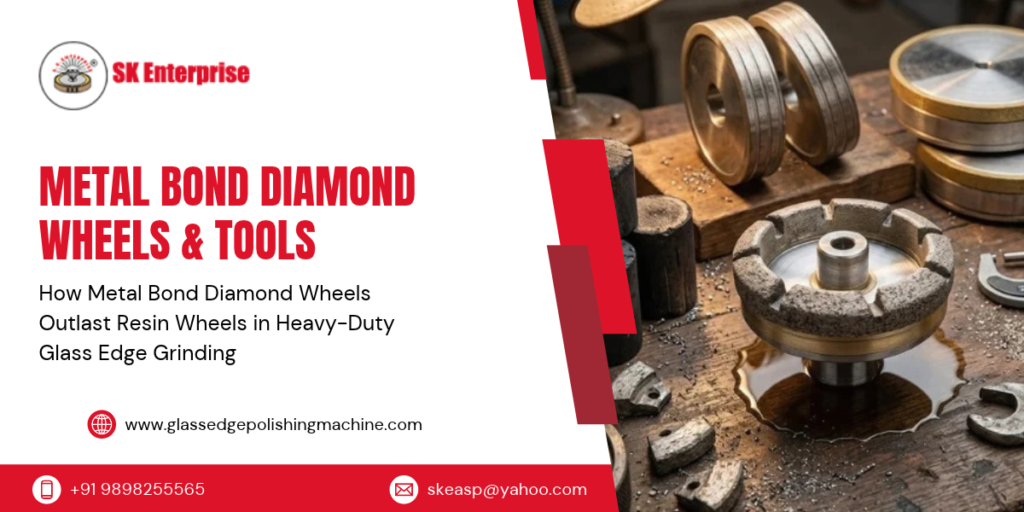
How Metal Bond Diamond Wheels Outlast Resin Wheels in Heavy-Duty Glass Edge Grinding
In modern architectural, furniture, interior partition, and automotive glass fabrication plants, grinding speed, edge straightness, and wheel longevity determine overall production profitability. Whether a workshop operates a high-speed multi-spindle straight-line edger, a double-edging conveyor line, or a heavy-duty beveling station, the abrasive diamond wheel contacting the raw glass edge performs all the mechanical stock removal.
When specifying diamond tooling for high-volume glass processing, plant managers, production supervisors, and machine operators constantly evaluate two primary bond systems: Sintered Metal Bond Diamond Wheels and Resin Bond Diamond Wheels. While both tooling types rely on industrial synthetic diamond crystals to cut hard soda-lime float glass, low-iron ultra-clear glass, and borosilicate glass, the structural matrix holding those diamond crystals behaves completely differently under heavy spindle loads and continuous shift operation.
Understanding how Metal Bond Diamond Wheels & Tools outperform resin-bonded wheels during rough and intermediate grinding stages helps glass fabricators slash monthly tooling budgets, eliminate frequent machine stoppages for manual wheel dressing, and achieve cleaner, chip-free edges ready for tempering or lamination.
1. The Powder Metallurgy Behind Sintered Metal Bond Diamond Wheels
A Metal Bond Diamond Wheel is engineered using precision powder metallurgy—blending high-grade synthetic monocrystalline or blocky diamond grits with powdered bronze, copper, tin, cobalt, or iron alloys and sintering them under extreme heat and hydraulic pressure onto a dynamically balanced steel core.
Why Metallic Matrices Anchor Diamonds Longer
Superior Mechanical and Chemical Grit Retention: During high-temperature sintering, the molten metallic alloy flows around each diamond crystal and solidifies into a dense, high-strength socket. Instead of ripping loose prematurely when encountering thick 10 mm, 12 mm, or 19 mm architectural glass or jagged score flare, each diamond crystal stays firmly anchored until its sharp cutting facets wear down naturally.
Controlled Self-Sharpening Matrix Erosion: As exposed diamond tips gradually dull from cutting hard silica glass, friction from microscopic glass swarf gently erodes the surrounding bronze-alloy matrix at a calibrated rate—continually exposing fresh, razor-sharp diamond edges without glazing over or losing cutting aggression.
3x to 5x Longer Service Life in Coarse & Medium Grits: In rough stock removal (60 to 180 mesh) and intermediate profile shaping (240 to 400 mesh), a high-density metal bond diamond wheel typically grinds three to five times more linear meters of glass than a comparable resin bond wheel before reaching end-of-life.
2. How Resin Bond Diamond Wheels Differ (And Where They Belong)
A Resin Bond Diamond Wheel suspends synthetic diamond grits inside a softer organic phenolic or polyimide polymer matrix rather than a metallic alloy:
Strengths in Fine Pre-Polishing Stages: Because the polymer resin matrix is softer and slightly elastic, it absorbs micro-vibrations during fine pre-polishing stages (500 to 1,200 mesh)—producing a smoother, uniform satin-matte surface with minimal subsurface micro-cracking right before final cerium oxide or felt polishing wheels.
Severe Weaknesses Under Heavy Stock Removal: If a resin bond wheel is forced to perform heavy roughing, thick arris chamfering, or deep wide-bevel stock removal, high contact pressure and localized frictional heat soften the organic polymer matrix rapidly. Diamond crystals pull out of the soft resin long before completing their cutting life—causing rapid wheel shrinkage, loss of geometric groove profile, burned glass edges, and costly wheel changeovers.
3. Six Key Advantages of Metal Bond Diamond Wheels in Glass Fabrication
Deploying sintered Metal Bond Diamond Wheels & Tools across roughing and intermediate shaping spindles delivers six measurable shop-floor advantages:
Aggressive Stock Removal Without Profile Deformation: Whether grinding flat edges with crisp 45-degree arrises, C-pencil profiles, bullnose edges, or OG decorative profiles, metal bond wheels hold their exact CNC-machined groove geometry across thousands of linear meters—preventing rounded corners or out-of-square edges.
Higher Conveyor Feed Speeds and Hourly Output: Rigid metallic matrices withstand higher spindle motor amperage and faster glass conveyor feed rates without chattering, flexing, or stalling—boosting daily square-meter output on straight-line and double-edging machines.
Superior Thermal Conductivity Away from the Glass Edge: Metal conducts frictional heat away from the cutting zone far more efficiently than thermally insulating resin polymers—reducing localized thermal shock and edge micro-chipping when paired with clean, well-directed flood water coolant.
Reduced Machine Downtime for Wheel Dressing and Depth Compensation: Because sintered metal bond wheels wear slowly and predictably, operators spend far less time halting production lines to dress glazed wheels with aluminum-oxide sticks or readjust manual and PLC spindle depth compensations.
Cleaner Edges Prior to Tempering Furnaces: Micro-chips and subsurface cracks left along a glass edge act as stress risers that trigger spontaneous glass breakage inside horizontal tempering furnaces. Metal bond wheels cut cleanly and consistently, dramatically lowering tempering furnace explosion rates.
Significantly Lower Cost Per Linear Meter of Processed Glass: Although a sintered metal bond wheel carries a slightly higher initial purchase price than a resin wheel, its 3x to 5x longer service life reduces total diamond tooling expenditure per linear meter of finished glass by 30% to 50%.
4. The Ideal Multi-Spindle Sequence: Combining Metal Bond, Resin Bond, and Polishing Wheels
On high-output multi-spindle Glass Edge Grinding & Polishing Machines and heavy-duty Glass Beveling Machines, leading glass processing plants combine both bond technologies in a progressive sequence to achieve maximum tool life alongside crystal-clear optical polish:
Spindles 1 & 2 (Rough & Medium Stock Removal — Metal Bond Diamond Wheels): Coarse 80/100 mesh and medium 180/240 mesh sintered metal bond cup wheels remove raw glass cutter score marks, flare, and heavy stock rapidly while establishing exact dimensional width and edge geometry.
Spindle 3 (Fine Pre-Polishing — Resin Bond Diamond Wheel): A 400/600 mesh resin bond diamond wheel erases coarse metal-bond scratch lines and prepares a uniform, smooth satin surface without deep subsurface micro-fissures.
Spindles 4, 5 & Beyond (Final Mirror Polishing — Cerium Oxide / Felt Wheels): Specialized pneumatic-compensated polishing wheels buff the satin edge to a distortion-free, mirror-bright finish.
5. Best Practices to Maximize Metal Bond Diamond Wheel Lifespan
Even the highest-grade sintered diamond wheel requires proper operating discipline to deliver its full service life:
Maintain Clean, High-Volume Water Coolant: Always direct clean, filtered water coolant (ideally kept below 100 micron suspended glass fines via settling tanks or centrifugal separators) directly into the wheel-to-glass contact arc. Running dry for even a few seconds overheats the bronze matrix and glazes diamonds permanently.
Dress Wheels Gently with Fine Aluminum-Oxide Sticks: When a wheel occasionally loads up with fine glass paste after thousands of meters, lightly touch a soft white aluminum-oxide dressing stick against the spinning wheel under full water flow for 2 to 3 seconds to expose fresh diamond grits—never force hard silicon-carbide bricks that strip away valuable metal matrix.
Verify Spindle Runout and Flange Cleanliness: Before mounting any new diamond cup or peripheral wheel, wipe the spindle arbor and mounting flange spotless so axial runout stays below 0.02 mm—eliminating uneven wheel wear and edge chatter marks.
Maximizing Diamond Tool Life Across Every Glass Processing Machine
Sintered metal bond diamond tools deliver dependable stock removal and clean edge geometry across every production and workshop machine in modern glass fabrication:
Sintered metal bond diamond wheels outlast resin bond wheels by 3x to 5x during coarse and medium glass edge grinding—delivering higher conveyor feed speeds, rigid profile retention, superior heat dissipation, cleaner tempering-ready edges, and lower per-meter tooling costs before transitioning to resin and polishing wheels for mirror finishing.
Looking to source long-life metal bond diamond cup wheels, peripheral profile wheels, beveling wheels, or diamond core drills matched to your exact glass thickness and spindle speed? Connect with the glass tooling specialists at Glass Edge Polishing Machine for high-performance diamond wheels and custom glass processing solutions.

 Users Today : 13
 Users This Month : 21
 Total Users : 22